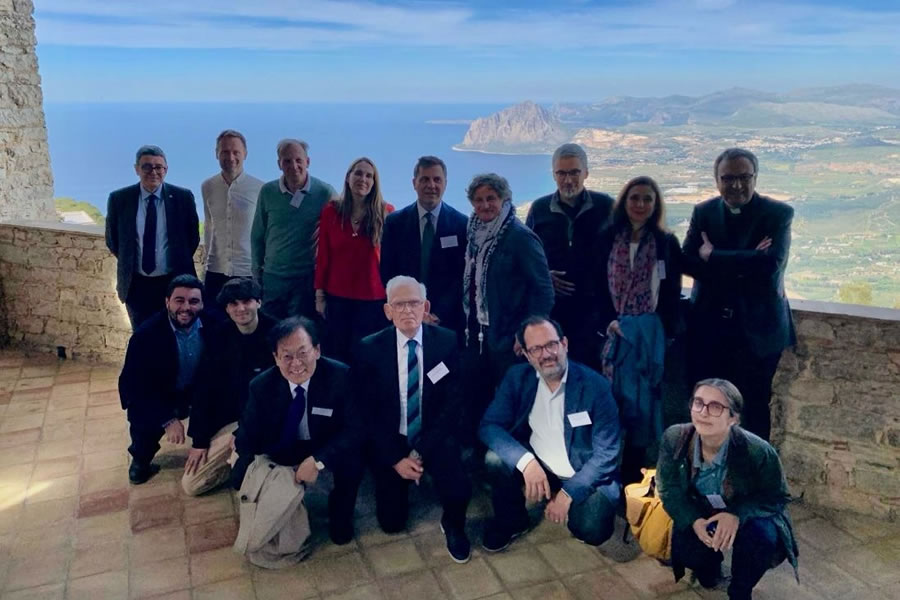
The first course of the International School on Artificial Intelligence: Technology and Law, promoted by the Ettore Majorana Foundation and the Centre for Scientific Culture, concluded on May 1, 2026, in the unique setting of Erice.
From April 27 to May 1, the School brought together researchers, students, and professionals from around the world around one of the most significant challenges of our time: understanding and governing an artificial intelligence that evolves faster than the rules designed to regulate it.
The initiative originated from the vision of Professor Antonino Zichichi: creating an interdisciplinary space capable of integrating science, law, ethics, and technology. In this context, the School emerged as an international laboratory in which AI was analyzed not only as a technology, but as a cognitive and social infrastructure.
A central role was played by CSAIA – Center for Advanced Studies on Artificial Intelligence, chaired by Professor Pier Paolo Maria Menchetti, co-director of the School together with Professor Axel Lehmann. CSAIA contributes to the development of AI governance models based on transparency, accountability, and interdisciplinary integration.
A Program Between Technology, Applications, and AI Regulation
The first module addressed the entire lifecycle of artificial intelligence in a structured way.- AI Foundations and Development: historical evolution and technological drivers (S.K. Oh, A. Lehmann, S. Greenman)
- Sector Applications: medicine and biomedical research (Menchetti, Buratti), finance (Medda), business (Di Pietra), smart cities (Al Sanad)
- Human–AI Interaction: (Chelli, Pulcini)
- Governance and Regulation: legal and regulatory aspects (Dellrud, Mazzitelli, Giuffrè, Occhipinti)
- Privacy and Intellectual Property: (Mainenti, Santacroce, Pouliou)
- Liability and Patents: (Ludovico)
- Cybersecurity and Ethics: (Braccioli, Scichilone)
Artificial Intelligence Between Innovation, Law, and Responsibility
The discussions highlighted a clear vision: artificial intelligence is not neutral. Its impact depends on the ways in which it is designed and governed. In this scenario, governance becomes central. AI evolves faster than regulations, but it requires new models integrating technology and law, capable of guiding its development. Another key topic concerned sustainability and energy: AI is becoming increasingly energy-intensive and requires advanced infrastructures, making strategic systemic choices necessary.Education and the Future: The Role of the Erice School
Education emerged as a strategic element. Without adequate skills and expertise, the impact of AI risks becoming difficult to govern. The School therefore positioned itself as an advanced educational platform capable of training new professional figures at the intersection of technology, law, and governance. Erice, historically a place of interdisciplinary exchange since 1963, thus confirmed its role as an international hub for scientific reflection, now projected toward the challenges of digital transformation and quantum computing.Next Appointment: September 2026
The program will continue in the coming months and will return to Erice from September 1 to 6, 2026, with the objective of assessing results and adapting to the continuous evolution of artificial intelligence. The International School today represents one of the most advanced examples of integration between research, education, and policy in the field of AI. Not to slow down progress, but to guide it.
Interview by Giornale di Sicilia with Professor Pier Paolo Maria Menchetti, co-director of the International School
The article published by Giornale di Sicilia offers a clear and accessible overview of the value of the International School of Erice, focusing on one of the most pressing contemporary challenges: the relationship between technological innovation and regulation, effectively represented by the idea of a challenge “between quantum and rules.”
Through the words of Professor Pier Paolo Maria Menchetti, an interdisciplinary approach emerges that integrates science, law, and ethics, highlighting how artificial intelligence is not merely a technology, but a phenomenon that must be governed with vision and responsibility. Particularly noteworthy is the reference to the prospects of quantum computing and the energy implications of AI.
It is an effective and informative contribution that succeeds in making complex topics understandable and deserves to be read in order to grasp the broader significance of the Erice initiative.