
by Anita Valentini
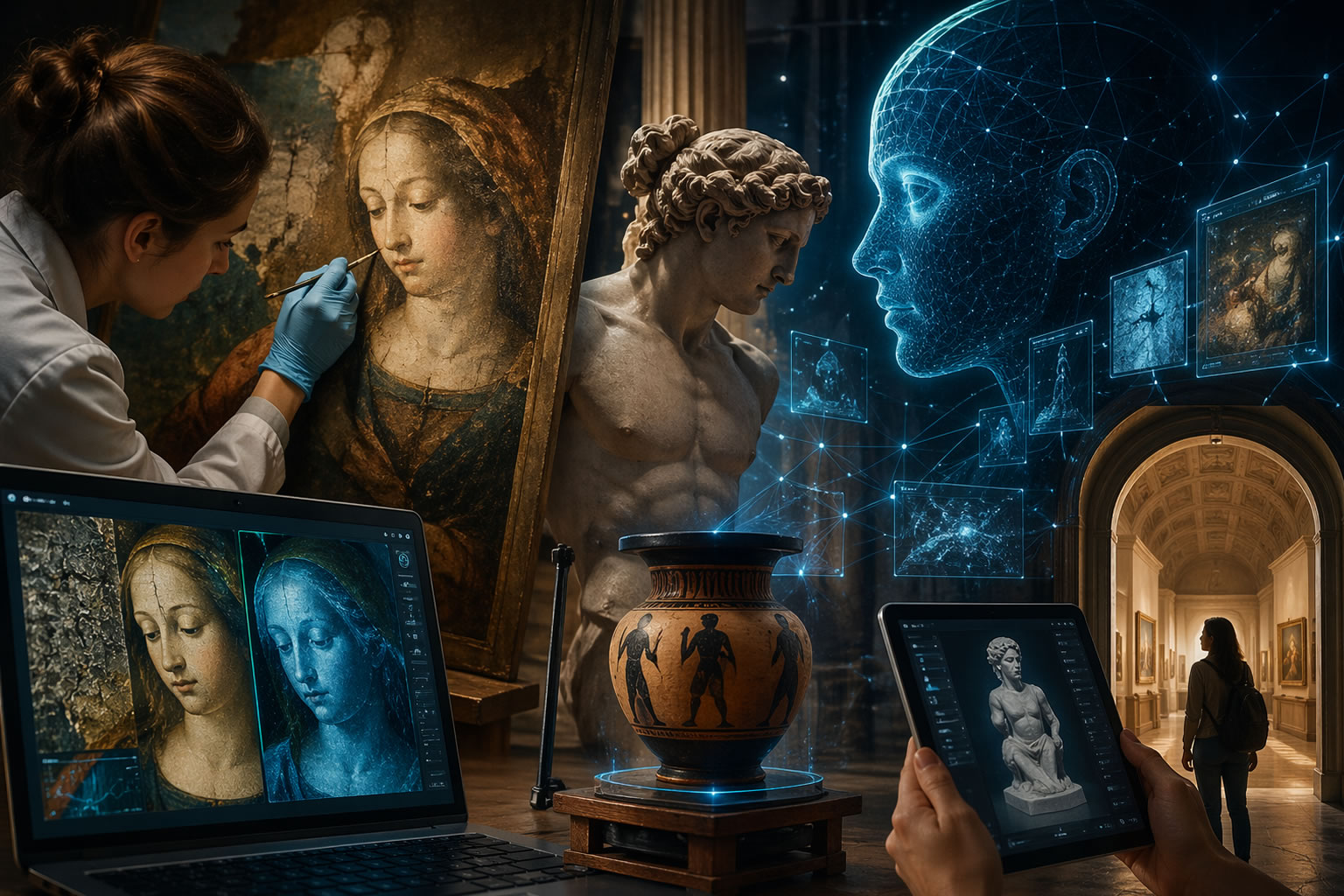
In recent years, the intersection between Artificial Intelligence (AI) and the knowledge, conservation, and restoration of cultural heritage has opened new paths for the study, protection, and accessibility of cultural assets.
Artificial intelligence is transforming cultural heritage conservation, improving the documentation and restoration of artifacts through technologies such as computer vision and natural language processing.
These advancements increase accessibility and provide new insights, but it is essential for the professionals who use AI and/or develop it for ART to possess cultural sensitivity.
Collaboration between technologists and cultural experts is indispensable to preserve our heritage and to ensure that future generations can appreciate and learn from our distinguished cultural history.
CSAIA believes in this!
THE WORKS OF ART AND THEIR HISTORY
1) UNDERSTANDING, CONSERVATION, AND RESTORATION
As David G. Stork emphasized in 2023, Artificial Intelligence is useful to art history because it enhances the understanding of artworks, revealing hidden details, recovering lost masterpieces, and opening stimulating perspectives on cultural heritage.
AI technologies, particularly computer vision, have proven to be powerful tools in this field. What is computer vision?
Computer vision is a field of artificial intelligence (AI) that uses machine learning and neural networks to teach computers and systems to derive meaningful information from digital images, videos, and other visual inputs, and to take action when defects or issues are identified.
Computer vision enables artificial intelligence to improve the cataloguing of artworks and also to assess their condition, predicting potential deterioration and guiding preventive measures. These models are trained on various datasets containing images of artworks both in good condition and deteriorated over time. By learning from these examples, the model becomes capable of recognizing elements that suggest the early stages of deterioration.
Once trained, the model can predict the evolution of an artwork’s condition. It may therefore identify areas at greater risk of cracking, paint loss, or color alteration, which could fade under current environmental conditions.
AI is capable of analyzing details, brushstrokes, and colors more accurately than the human eye — essentially everything that reveals the expressive intentions of artists.
For example, AI analysis of the painting Girl with a Pearl Earring (1665) by Johannes Vermeer, the celebrated seventeenth-century Dutch painter, provides a deeper understanding of how the artist represented light by observing details such as the reflections in the girl’s eyes and pearl, as well as the shadow cast by her nose on her face.
Through the analysis of vast datasets, AI is capable of rapidly identifying the specific characteristics of a single artist and understanding correlations between authors, as demonstrated in the study of the Madonna della Rosa (1518), housed at the Prado Museum in Madrid. Initially considered entirely the work of Raphael, from the nineteenth century onward art historians hypothesized that the figure of Joseph and a lower section of the painting had been executed by different hands from Raphael’s workshop (Giulio Romano and Giovan Francesco Penni) or from a later period (particularly regarding the rose detail).
Recently, thanks to the use of an artificial intelligence algorithm developed at the University of Bradford by Hassan Ugail, professor of visual computing, the painting was analyzed in detail, concluding that most of the work is indeed by Raphael, while Joseph’s face was painted by another artist.
The AI had been trained on 49 undisputed works by Raphael, achieving 98% accuracy in recognizing authentic paintings by the artist by examining details such as the color palette, tonalities, and brushstrokes.
The power of AI in art is also evident in the important field of artwork recovery, reconstructing missing sections or recreating images of destroyed or dispersed works. One significant example concerns the painting Medicine (1899–1907, oil on canvas for the ceiling of the Great Hall of the University of Vienna) by Gustav Klimt, which was lost in 1945 during the Second World War in the fire at Immendorf Castle. The painting by the leading artist of the Viennese Secession was recovered — or more precisely, made visible again — thanks to neural networks trained on preparatory sketches, photographs, and textual data. Digitally reconstructed, it was exhibited in 2022 at the former Church of Carmine in Piacenza during the exhibition Klimt. The Man, the Artist, His World.
Algorithms have also brought to light parts of damaged paintings and/or works hidden beneath other artworks, as in the case of The Two Wrestlers by Vincent Van Gogh, discovered beneath the painting Still Life with Meadow Flowers and Roses, exhibited at the Kröller-Müller Museum in the village of Otterlo in the Netherlands, dating back to 1886. Until 1998, the floral work had been attributed to an anonymous painter, although it was suspected to have been painted by Van Gogh. That year, an X-ray revealed, beneath the faded flowers and melancholic colors of the still life, the spectral image of two bare-chested wrestlers. Thus, the hidden image created by Van Gogh during his stay at the Academy of Fine Arts in Antwerp, Belgium, in 1885 or 1886, was brought to light. Later in Paris, the painter repainted the canvas with the still life composition. In 2012, the content of the hidden painting was fully confirmed, as was the authorship of “both” works. The artwork The Two Wrestlers, which contained missing sections, was completed through AI, allowing the creation of a computerized overall visualization.
2) DETECTION OF ART FORGERIES
Another field of art in which artificial intelligence plays an important role is the detection of forgeries. Artificial intelligence is becoming a valuable ally in significantly improving the identification of art forgeries through advanced analytical techniques and algorithms. AI systems can examine artworks to identify subtle inconsistencies and anomalies indicative of falsification. These computer vision models analyze brushstrokes, color palettes, and material compositions, comparing them with databases of known authentic works and thereby identifying discrepancies.
Machine learning algorithms can evaluate the aging process of materials by analyzing the various characteristics that develop over time, such as oxidation patterns, surface wear, and changes in chemical composition.
Algorithms are trained on extensive datasets containing both naturally and artificially aged materials, enabling them to distinguish between authentic patina and the uniform or inconsistent patterns often found in forgeries. This technological advancement not only helps preserve the authenticity of art collections, but also contributes to maintaining the integrity of the art market by providing robust verification tools.
However, it remains essential to integrate AI analysis with expert human judgment capable of taking into account the complexities of artistic expression.
We can nevertheless affirm that AI-driven art forgery detection represents a powerful tool for safeguarding cultural heritage and ensuring the authenticity of artworks.
AI as a support tool for human beings; we emphasize this particularly in a country like Italy, which has always been at the forefront of cultural heritage protection in every field. Italy, through its legislation — beginning with Article 9 of the Constitution (1948 and subsequent amendments) — and through the Carabinieri Command for the Protection of Cultural Heritage (TPC), possesses legislation and an operational body of excellence that are internationally recognized as outstanding models worldwide.
3)DIGITIZATION OF ANCIENT TEXTS
Artificial intelligence is also transforming the digitization of ancient texts through technologies such as natural language processing (NLP) and computer vision. High-resolution scanning and AI-enhanced image preprocessing improve the readability of faded manuscripts, while optical character recognition systems, more commonly known as OCR systems (enhanced by AI), convert handwritten or printed characters into machine-readable text.
These systems offer text segmentation, whereby text is isolated from other elements such as images or decorations, ensuring that only the relevant text is processed.
Such systems are trained using large and diversified datasets composed of digitized texts, handwriting samples, and linguistic examples from different historical periods and languages.
As illustrated in the research paper Quantitative Analysis of Literary Style, by analyzing these datasets, artificial intelligence learns the linguistic patterns, common phrases, and stylistic nuances characterizing specific authors or historical periods.
Once trained, AI uses pattern recognition to analyze intact portions of text, identifying the specific style, grammar, and syntax involved.
AI can thus generate plausible reconstructions of missing sections, inferring what may originally have been written.
As in the restoration of works of art, artificial intelligence can therefore be used to reconstruct missing or damaged sections of texts caused by mold, fire damage, and other forms of deterioration, making ancient documents accessible to scholars and the public worldwide.
This process is fundamental for facilitating research.
AI can also improve preservation and ensure the long-term protection of archival and library cultural heritage by providing recommendations and guidance in this field.
4) ARCHITECTURE AND ARCHAEOLOGY
Another field in which artificial intelligence is becoming increasingly fundamental is archaeology and architecture, beginning with the creation of digital replicas and virtual reconstructions of monuments and historical sites. These technologies provide both the data necessary for possible restoration interventions and immersive experiences, while also minimizing the need for physical interaction with “fragile” buildings and sites or locations that are partially difficult to access. These digital models, in fact, serve as valuable references for restoration and educational purposes.
An important example of the role of artificial intelligence in the restoration of historical sites is represented by the work carried out on the Flavian Amphitheatre in Rome (the Colosseum). Researchers from the University of Rome Sapienza used AI-powered image recognition technology to carefully analyze the great architectural undertaking behind the construction of the Colosseum and the subsequent restoration interventions carried out on the structure.
AI algorithms meticulously identify cracks, erosion patterns, and subtle structural shifts, enabling restoration experts to implement targeted, effective interventions that respect the historical integrity of the Colosseum.
Architecture
Artificial intelligence is becoming increasingly indispensable in interventions aimed at the recovery, restoration, and conservation of existing architectural heritage, offering innovative strategies for assessing deterioration.
AI can be effectively implemented in the context of architecture and conservation only starting from an HBIM (Heritage Building Information Modeling) model, an extremely information-rich 3D digital representation of a structure, designed to faithfully reproduce the artifact’s geometric, material, architectural, physical, and other characteristics.
What is architectural conservation?
Architectural conservation refers to the process aimed at protecting the immovable cultural heritage of the past, with the purpose of preserving its historical testimony and transmitting its value to future generations.
According to the Code of Cultural Heritage and Landscape (Urbani Code, Legislative Decree of January 22, 2004, no. 42 pursuant to Article 10 of Law no. 137 of July 6, 2002), updated with the amendments introduced by Legislative Decree no. 139 of September 18, 2024 and Legislative Decree no. 190 of November 25, 2024, the conservation of cultural heritage — which naturally also includes buildings of historical and artistic interest — can only be ensured “through a coherent, coordinated, and planned activity of study, prevention, maintenance, and restoration,” aimed at:
- limiting risk situations connected to cultural heritage within its context;
- monitoring and maintaining over time the identity, physical conditions, and functional efficiency of the asset and all its parts;
- recovering, whenever necessary, the material integrity and cultural values of the heritage itself.
- detection and mapping of inaccessible points: drones equipped with intelligent sensors make it possible to reach the most inaccessible parts of a structure and carry out aerial surveys and 3D point cloud acquisitions to be imported into modeling software for the construction of HBIM models. Artificial intelligence also allows certain systems to analyze collected data and images in order to assess the state of deterioration of the asset and automatically identify areas requiring intervention or restoration;
- diagnostics and monitoring: starting from an HBIM model, it is possible to develop an intelligent system capable of interacting with the building in real time in order to monitor the condition of the structure and propose appropriate solutions for its proper management and conservation. Intelligent sensors positioned at strategic points within the building make it possible to monitor all significant parameters (physical, structural, environmental, functional, etc.) and implement targeted intervention strategies aimed at solving specific problems;
- reassembly of fragmented artifacts: AI technology can be used for the reconstruction of ancient artifacts through intelligent robots capable of autonomously processing, matching, and physically assembling fragmented remains that are difficult for humans to reconstruct manually, doing so in short periods of time. Recently, an experimental project was conducted at the Archaeological Park of Pompeii, where a robotic infrastructure combined with 3D scanning technologies and machine learning and computer vision techniques was developed for the restoration and reconstruction of the magnificent ceiling frescoes of the House of the Painters at Work and the Schola Armaturarum;
- preventive conservation: artificial intelligence makes it possible to develop predictive models capable of identifying risk and vulnerability factors for historically significant buildings (as well as more recent constructions), based on multi-scenario studies evaluating environmental risks, climate change, levels of building use, structural aspects, and more.
5) TOURISM, A VITAL SECTOR FOR ITALY
The integration of AI into the conservation and enhancement of cultural heritage already plays, and will increasingly continue to play, a fundamental role in the Tourism sector, of which cultural heritage constitutes an essential and indispensable component in Italy and in all countries with a great historical legacy, past and/or present.
The Museum System
Museums, places of conservation, education, and research, are increasingly embracing digital and interactive experiences: AI can generate content such as texts, images, and videos; it can also produce podcasts capable of engaging an increasingly diverse audience in terms of geographical origin, culture, interests, and age groups.
Virtuous Museum Experiences, An Exemplary Case
A first step has already been taken by the Vatican City Museum Complex toward a perfect integration between technology and culture, without altering the charm of art and history. The objective was to create an efficient, engaging, and attractive Smart Museum for its visitors, also through 3D online tours.
To implement the project, the Museum’s central platform — responsible for its most important functions — was first enhanced. The platform manages the security systems of all the museum halls: it monitors every aspect, from fire alarms to sensors capable of detecting the number of people present in each room.
An AI integrated into the surveillance systems platform was then installed. The AI provides tools to illustrate and explain the museum while simultaneously directing visitors toward the safest and nearest exits in the event of an emergency.
Another particularly interesting application implemented concerns the regulation of crowding, preventing excessive gatherings inside the various exhibition rooms.
The Importance of Combining Technology and Culture
The digitization of an experience such as that of the Vatican Museums (extraterritorial, yet exemplary for Italian museography) is extremely important and serves as a strong example for similar institutions. Investing in technology — through apps, social networks, and virtual reality — represents the future of a sector as vast as it is economically valuable, namely culture.
In Italy, the Egyptian Museum of Turin is among the innovative museums making use of AI, thanks in part to the work of Professor Davide Mezzino of IULM University, partner of CSAIA ETS.
In Italy, it is necessary to do more; a substantial transformation is essential to revitalize this sector. We are the leading country in the world in terms of the number of UNESCO sites!
When it comes to museums, AI can be incorporated in various ways, from enhancing visitor experiences to supporting behind-the-scenes operations.
AI can improve visitors’ experiences and their access to museums through websites, chatbots, and analytical tools.
By making systems more efficient, it is important to emphasize that museums can save both time and money while simultaneously increasing their revenue streams.
AI-generated content, capable of analyzing and interpreting data and information, can create or generate texts, images, and videos.
Such content plays an important role within museum visits and virtual exhibitions, where visitors come into contact with generative art.
For example, the Louvre Museum in Paris has developed a virtual tour that uses AI-generated content. The virtual tour includes 360° visits to the museum’s most famous exhibition sections; a tour that enhances audio and video guides while also providing in-depth insights through visual search functions available on tourists’ smartphones.
Cultural institutions can create interactive exhibitions that respond to visitors’ preferences, provide virtual tours of historical sites no longer accessible to the public, or create virtual exhibitions for visitors unable to attend in person because of mobility issues or other limitations.
AI, through digital replicas and virtual reconstructions, offers immersive experiences and can minimize physical interaction with delicate artifacts or, conversely, enhance the possibility of exploring works at 360°, especially those that, in their usual placement, allow only partial viewing.
And all this also applies to nature tours, as well as landscape and environmental heritage sites.
Fundamental for inclusive education!
From this perspective, museums may even develop humanoid robotic operators designed to answer visitors’ questions.
In 2015, the French company Aldebaran Robotics developed a humanoid robot called Pepper.
Today, these robots are highly востребованы and are employed in various tourist and cultural sites, including, for example, the three museums that make up the Smithsonian Museum in Washington.
6) CONCLUSIONS
One might reflect on the lesson of Immanuel Kant’s Critique of Judgment (1790), according to which “In beauty, it is not knowledge of the concept, but intuition, that decides.” AI may fail to grasp the deepest aspects — those not susceptible to logical or quantitative measurement — aspects that only the human approach can fully understand.
However, AI represents a valuable support tool that can be further developed, for example by integrating the chemical analysis of pigments in artworks, thereby expanding its potential in the field of artistic authentication.
The future of AI in cultural heritage conservation could lead to remarkable advancements capable of further transforming the way we protect and utilize cultural assets. As AI technology continues to evolve, we can expect increasingly sophisticated applications in areas such as virtual reality, augmented reality, and machine learning algorithms.
These technologies will enable even more immersive and interactive experiences, allowing people around the world to explore and appreciate cultural heritage in ways never seen before.
Contribution presented at the following conferences organized by the Italian Chamber of Deputies and the University for Peace – United Nations Mandated in collaboration with CSAIA ETS:
ARTIFICIAL INTELLIGENCE
New Challenges: from Advanced Research in Medicine, to Cybersecurity, to Art & Humanities.
Sala della Regina – Palazzo Montecitorio – Rome
February 25, 2025 – 10:00 a.m.
ARTIFICIAL INTELLIGENCE
Social, Labor, Geopolitical and Geoeconomic Impact.
University for Peace – United Nations Mandated
Palazzo Falletti, Via Panisperna 207, Rome
June 11, 2025 – 10:00 a.m.–4:00 p.m.


