
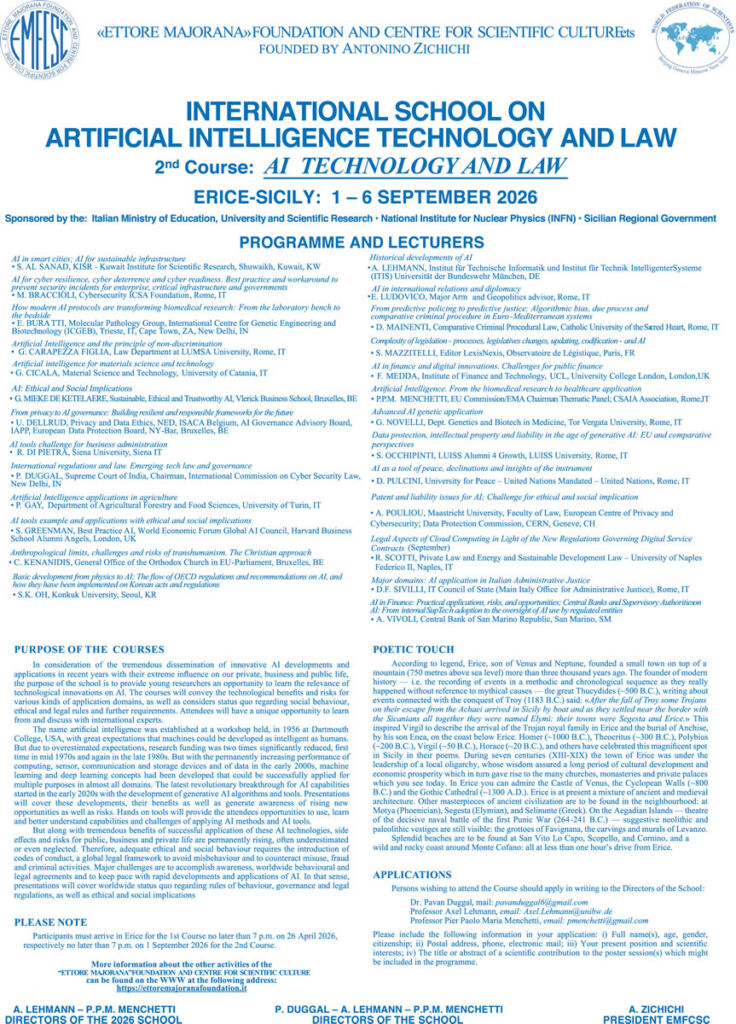
2nd Course: AI Technology and Law
Directors: A. LEHMANN – P.P.M. MENCHETTI
INTERNATIONAL SCHOOL ON ARTIFICIAL INTELLIGENCE TECHNOLOGY & LAW
ERICE – SICILY
ERICE-SICILY, 1 – 6 September 2026
COURSE OBJECTIVES
PROGRAMME AND LECTURERS
2nd Course: AI Technology and Law – Erice, Sicily | 1–6 September 2026
AI in Smart Cities; AI for Sustainable Infrastructure
S. AL SANAD
Kuwait Institute for Scientific Research (KISR), Shuwaikh, Kuwait (KW)
AI for Cyber Resilience, Cyber Deterrence and Cyber Readiness. Best Practice and Workaround to Prevent Security Incidents for Enterprise, Critical Infrastructure and Governments
M. BRACCIOLI
Cybersecurity ICSA Foundation, Rome, Italy (IT)
How Modern AI Protocols Are Transforming Biomedical Research: From the Laboratory Bench to the Bedside
E. BURATTI
Molecular Pathology Group, International Centre for Genetic Engineering and Biotechnology (ICGEB), Trieste, Italy (IT); Cape Town, South Africa (ZA); New Delhi, India (IN)
Artificial Intelligence and the Principle of Non-Discrimination
G. CARAPEZZA FIGLIA
Law Department, LUMSA University, Rome, Italy (IT)
Artificial Intelligence for Materials Science and Technology
G. CICALA
Materials Science and Technology Department, University of Catania, Italy (IT)
AI: Ethical and Social Implications
G. MIEKE DEKETELAERE
Sustainable, Ethical and Trustworthy AI, Vlerick Business School, Brussels, Belgium (BE)
From Privacy to AI Governance: Building Resilient and Responsible Frameworks for the Future
U. DELLRUD
Privacy and Data Ethics; NED; ISACA Belgium; AI Governance Advisory Board, IAPP; European Data Protection Board; NY Bar Association, Brussels, Belgium (BE)
AI Tools Challenge for Business Administration
R. DI PIETRA
University of Siena, Siena, Italy (IT)
International Regulations and Law: Emerging Tech Law and Governance
P. DUGGAL
Supreme Court of India; Chairman, International Commission on Cyber Security Law, New Delhi, India (IN)
Artificial Intelligence Applications in Agriculture
P. GAY
Department of Agricultural Forest and Food Sciences, University of Turin, Italy (IT)
AI Tools Example and Applications with Ethical and Social Implications
S. GREENMAN
Best Practice AI, World Economic Forum Global AI Council, Harvard Business School Alumni Angels, London, United Kingdom (UK)
Anthropological Limits, Challenges and Risks of Transhumanism. The Christian Approach
C. KENANIDIS
General Office of the Orthodox Church in EU-Parliament, Brussels, Belgium (BE)
Basic Development from Physics to AI: The Flow of OECD Regulations and Recommendations on AI, and How They Have Been Implemented in Korean Acts and Regulations
S.K. OH
Konkuk University, Seoul, South Korea (KR)
Historical Developments of AI
A. LEHMANN
Institut für Technische Informatik and Institut für Technik Intelligenter Systeme (ITIS), Universität der Bundeswehr München, Germany (DE)
AI in International Relations and Diplomacy
E. LUDOVICO
Major Arm and Geopolitics Advisor, Rome, Italy (IT)
From Predictive Policing to Predictive Justice: Algorithmic Bias, Due Process and Comparative Criminal Procedure in Euro-Mediterranean Systems
D. MAINENTI
Comparative Criminal Procedural Law, Catholic University of the Sacred Heart, Rome, Italy (IT)
Complexity of Legislation – Processes, Legislative Changes, Updating, Codification – and AI
S. MAZZITELLI
Editor, LexisNexis; Observatoire de Légistique, Paris, France (FR)
AI in Finance and Digital Innovations. Challenges for Public Finance
F. MEDDA
Institute of Finance and Technology, UCL – University College London, London, United Kingdom (UK)
Artificial Intelligence: From Biomedical Research to Healthcare Application
P.P.M. MENCHETTI
EU Commission / EMA Chairman Thematic Panel; CSAIA Association, Rome, Italy (IT)
Data Protection, Intellectual Property and Liability in the Age of Generative AI: EU and Comparative Perspectives
S. NOVELLI
Dept. Genetics and Biotech in Medicine, Tor Vergata University, Rome, Italy (IT)
Data Protection, Intellectual Property and Liability in the Age of Generative AI: EU and Comparative Perspectives
S. OCCHIPINTI
LUISS Alumni 4 Growth, LUISS University, Rome, Italy (IT)
AI as a Tool of Peace: Declarations and Insights of This Instrument
D. PULCINI
University for Peace – United Nations Mandated, United Nations, Rome, Italy (IT)
Patent and Liability Issues for AI: Challenge for Ethical and Social Implication
A. POULIOU
Maastricht University, Faculty of Law; European Centre of Privacy and Cybersecurity; Data Protection Commission; CERN, Geneva, Switzerland (CH)
Legal Aspects of Cloud Computing in Light of the New Regulations Governing Digital Service Contracts
R. SCOTTI
Private Law and Energy and Sustainable Development Law – University of Naples Federico II, Naples, Italy (IT)
Major Domains: AI Application in Italian Administrative Justice
D.F. SIVILLI
Council of State (Main Office for Administrative Justice), Rome, Italy (IT)
AI in Finance: Practical Applications, Risks and Opportunities; Central Banks and Supervisory Authorities on AI: From Internal SupTech Adoption to the Oversight of AI by Regulated Entities
A. VIVOLI
Central Bank of San Marino Republic, San Marino (SM)
POETIC TOUCH
APPLICATIONS
Those wishing to participate in the Course should submit a written application to the Directors of the School:
- Dr. Pavan Duggal, e-mail: pavanduggal6@gmail.com
- Professor Axel Lehmann, e-mail: Axel.Lehmann@unibw.de
- Professor Pier Paolo Maria Menchetti, e-mail: pmenchetti@gmail.com
Please include the following information in the application:
- Full name, age, gender, nationality;
- Postal address, telephone number, e-mail;
- Current position and scientific interests;
- Title or abstract of a scientific contribution for the poster session(s), which may be included in the program.
PLEASE NOTE
Participants must arrive in Erice for the 1st Course no later than 7:00 PM on April 26, 2026 and, for the 2nd Course, no later than 7:00 PM on September 1, 2026.
“ETTORE MAJORANA FOUNDATION AND CENTRE FOR SCIENTIFIC CULTURE”
is available on the website at the following address:
https://ettoremajoranafoundation.it


