
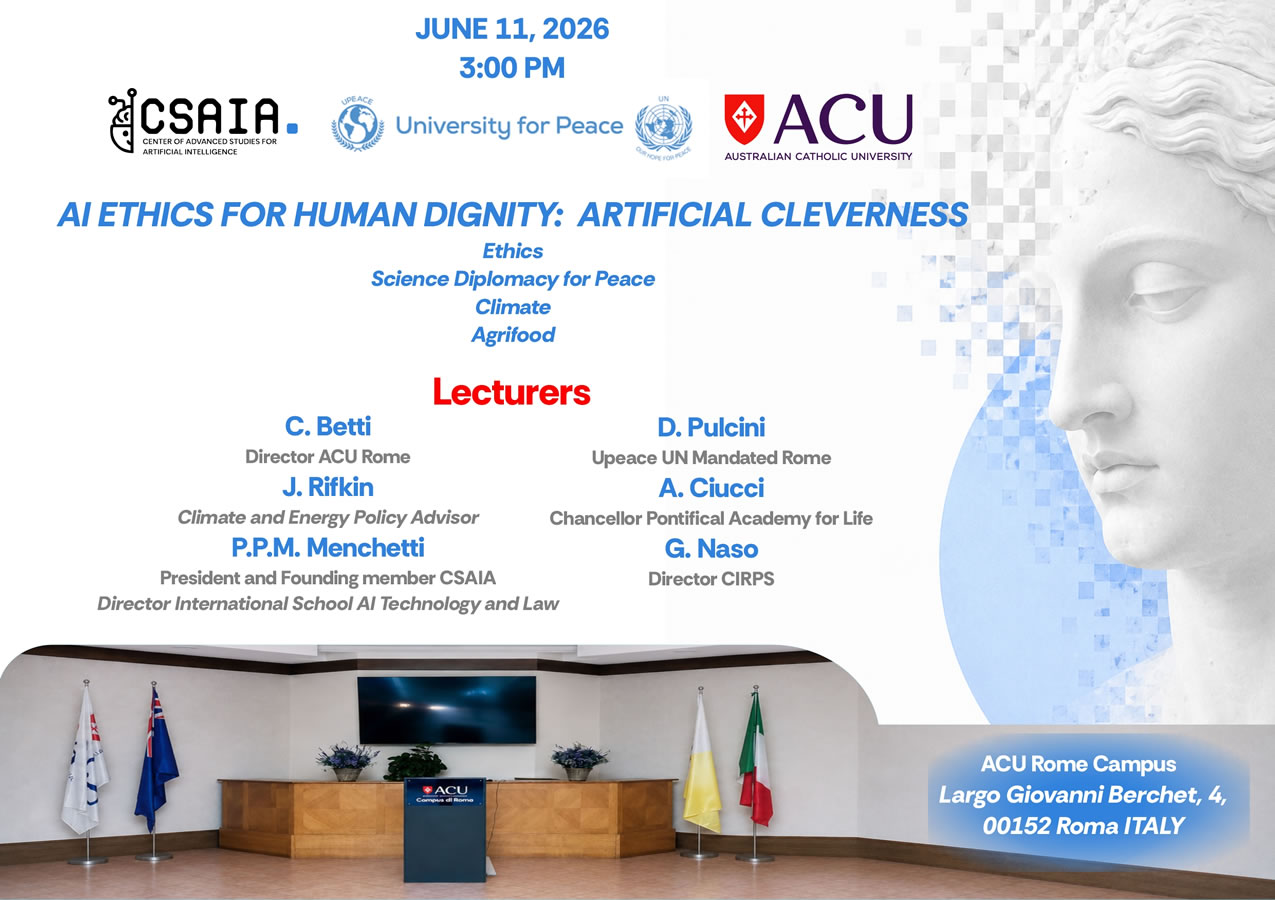
Jeremy Rifkin, a guest of CSAIA and UPEACE Rome at the prestigious Australian Catholic University Campus of Rome, argues that we are facing two competing worldviews. The first is based on what he calls an “ontology of substance”, a conception that views reality as a collection of separate and autonomous entities and that tends to translate into the concentration of data, computational capacity, and decision-making power in the hands of a few major actors. The second is an “ontology of process”, which interprets life as a network of relationships, interdependencies, collaboration, and continuous evolution.
According to Rifkin, the future of artificial intelligence will largely depend on which of these two visions ultimately prevails. Alongside today’s dominant technology platforms, he foresees the emergence of what he calls “People’s AI”—an artificial intelligence developed through distributed innovation ecosystems, open networks, small and medium-sized enterprises, cooperatives, and commons-based governance models capable of generating collective intelligence on a global scale.
A crucial role in this transformation could be played by Generation Z. Rifkin describes this generation as an emerging force capable of understanding human existence in increasingly interactive, collaborative, and community-oriented terms. As Generation Z enters institutions, businesses, civil society, and the research community, it brings with it a different conception of value creation—one based not only on competition but also on cooperation, participation, and shared responsibility.
In an era marked by climate change, digital transformation, geopolitical tensions, and the rapid evolution of artificial intelligence, Jeremy Rifkin invites us to ask a fundamental question: Will technology reinforce today’s concentrations of power, or can it become a catalyst for resilience, sustainability, and collaboration?
One of the most influential thinkers, from the Third Industrial Revolution to the European Green Deal, Jeremy Rifkin challenges us to envision an artificial intelligence designed for human beings.


