
by Mario Agostinelli and Sergio Bellucci
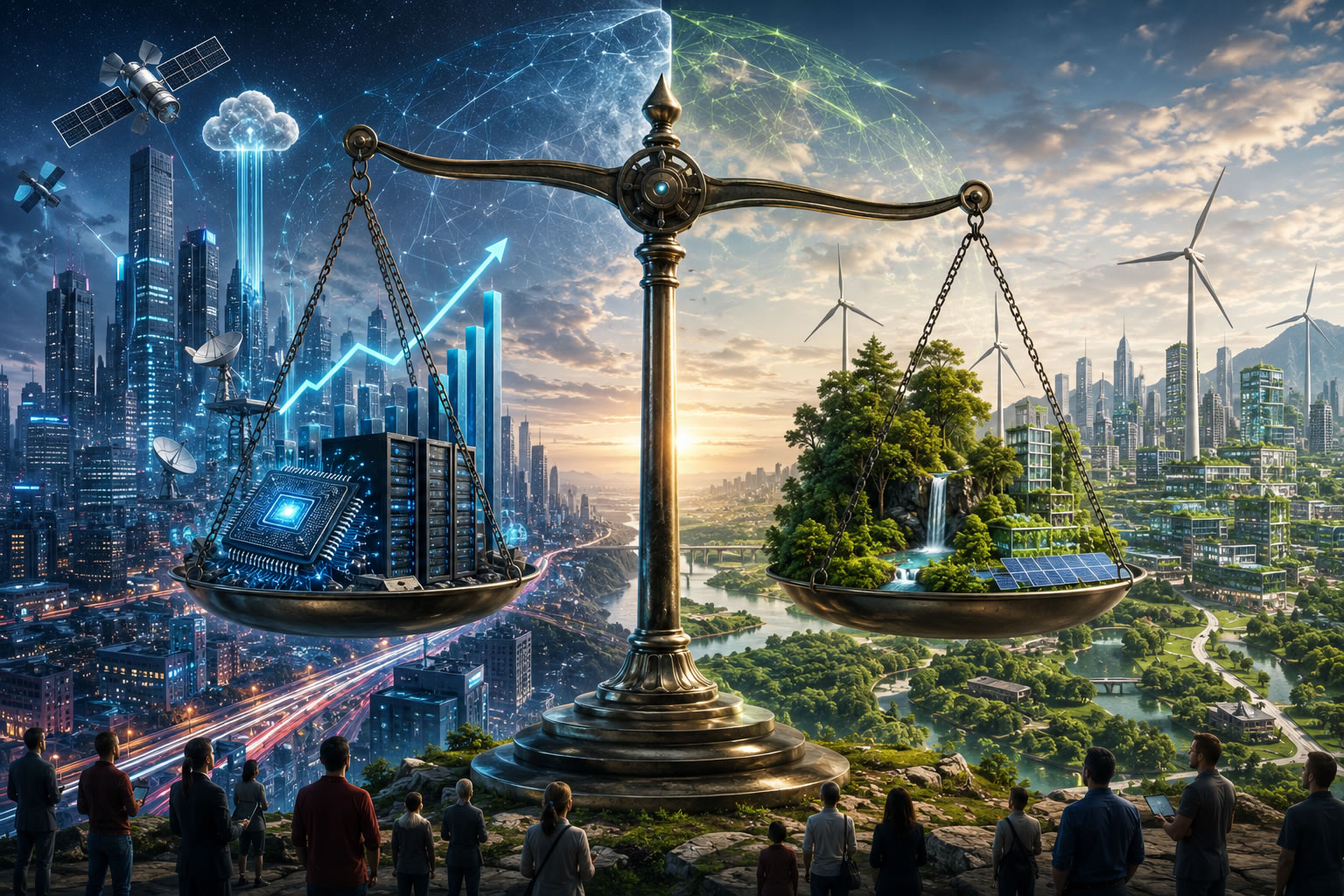
Beyond its social and cultural costs, AI also has physical costs: energy and water.
In response to public opposition, Big Tech is turning to nuclear power,
while AI is already operating within a financial bubble.
When discussing artificial intelligence, public debate almost always focuses on opportunities: increased productivity, process automation, service innovation, decision support, and economic growth. Much less attention is devoted to an issue that is set to become increasingly central in the coming years: the energy and environmental cost of the digital revolution.
One of the most important and least discussed topics concerns the relationship between artificial intelligence, data centers, electricity consumption, and sustainability. Behind every request sent to ChatGPT, every image generated by an AI model, and every algorithm supporting businesses and public administrations lies a physical infrastructure made up of servers, specialized processors, telecommunications networks, and cooling systems that require enormous amounts of energy.
Artificial intelligence is therefore not an immaterial technology. It is an economic, industrial, and geopolitical infrastructure that is reshaping the balance between innovation, the environment, markets, and power.
The Strategic Role of Data Centers
At the heart of the AI ecosystem are data centers. These facilities host thousands of servers and processing systems that enable the training and execution of artificial intelligence models.
Available evidence shows an impressive increase in the energy consumption associated with these infrastructures. In 2024, data centers consumed approximately 415 TWh of electricity globally, an amount exceeding the annual consumption of many industrialized countries. Forecasts indicate that by 2030 this figure could exceed 900 TWh, driven primarily by the spread of generative artificial intelligence.
This phenomenon is not limited to the United States or China. Europe and Italy are also experiencing a strong acceleration in investments in the sector. In Italy, data center electricity consumption is estimated to rise from around 7 TWh in 2024 to more than 20 TWh by 2030, with particularly strong growth concentrated in the Milan metropolitan area.
The Myth of Immaterial Technology
One of the most widespread misconceptions is the idea that digital technologies are immaterial and therefore essentially free of environmental impacts.
The reality is very different.
Every online activity requires energy to power servers, networks, and devices. The global digital ecosystem already accounts for a significant share of worldwide energy consumption and continues to grow rapidly.
Added to this is the water required to cool data centers, the production of increasingly advanced chips, and the use of critical materials throughout the technological supply chain. The growth of artificial intelligence therefore entails a tangible environmental impact that cannot be ignored.
CO₂ emissions associated with the digital ecosystem are also becoming increasingly significant. Training advanced AI models requires enormous amounts of energy and contributes to the growing carbon footprint of the technology sector.
Big Tech and the Concentration of Power
The expansion of artificial intelligence is not merely a technological transformation. It is also an economic and political transformation.
Google, Microsoft, Amazon, Meta, OpenAI, and Nvidia are investing hundreds of billions of dollars in digital infrastructure, data centers, cloud computing, and processing capacity.
This investment race is driving an increasing concentration of economic and informational power in the hands of a very limited number of global players. Data, computational capacity, and access to digital platforms are becoming strategic resources comparable to energy infrastructure or transportation networks.
The result is the emergence of highly centralized ecosystems in which a small number of entities control an ever-growing share of information, digital relationships, and technological capabilities worldwide.
Protests Against Data Centers
The impact of artificial intelligence is not limited to financial markets or major technology hubs.
In the United States, local movements opposing the construction of new data centers are becoming increasingly common. In several areas of the Rust Belt and Virginia, citizens and local communities are challenging projects perceived as invasive and potentially harmful to their territories.
The main concerns involve electricity consumption, water use, rising energy costs, and potential impacts on property values.
These protests highlight a fundamental issue: while the economic benefits of artificial intelligence tend to be concentrated in the hands of a few large operators, a significant portion of the environmental and infrastructural costs is borne by local communities.
Why Big Tech Is Looking at Nuclear Power
Growing energy demand is pushing many technology companies to seek new sources of supply.
Microsoft, Amazon, Google, and OpenAI are evaluating direct or indirect investments in the nuclear sector, with particular attention to Small Modular Reactors (SMRs).
The objective is to ensure a stable and continuous energy supply for infrastructures that must operate twenty-four hours a day, seven days a week.
This strategy is presented as a response to the growing electricity demand generated by AI. However, the debate remains open. The time required to build nuclear plants, their high investment costs, and their environmental and social implications continue to raise significant concerns.
Centralization or Decentralization?
One of the most interesting aspects concerns the comparison between two models of digital development.
On one side stands the centralized model, dominated by large proprietary platforms that control data, infrastructure, and services.
On the other side emerges the prospect of decentralized models based on open standards, open-source software, interoperability, and a broader distribution of value.
This contrast is not merely technological. It concerns how economic power, platform governance, and citizens’ ability to retain control over their own data will be distributed.
The future of artificial intelligence will also depend on the balance achieved between these two visions.
The Sustainability Challenge
The central issue is not stopping the development of artificial intelligence but making it compatible with environmental and energy sustainability goals.
Solutions do exist.
Data center efficiency continues to improve. Renewable energy sources are becoming increasingly competitive. Energy storage systems enable more effective management of power generation. Artificial intelligence itself can help optimize energy consumption, power grids, buildings, and industrial processes.
It therefore becomes essential to direct investments toward models capable of reducing the energy intensity of digital systems and promoting greater integration with renewable energy sources.
The growth of AI cannot be evaluated solely in terms of technological performance or financial returns. It must also be measured in relation to its environmental, social, and territorial impacts.
Conclusions
Artificial intelligence represents one of the most revolutionary technologies of our time. At the same time, it brings challenges that extend far beyond technical considerations.
Energy consumption, the use of natural resources, the concentration of economic power, platform governance, and environmental sustainability are all issues that will become increasingly relevant in public debate.
The real question is not only what artificial intelligence will be capable of doing, but also what development model will accompany its expansion.
The challenge of the coming years will be to build a digital ecosystem capable of combining innovation, efficiency, sustainability, and democracy. Only in this way can AI-driven transformation generate value not only for markets, but also for society and the planet.


