by Anna Prisco
Assistant Professor of Business Management, University of Naples Federico II, Department of Economics, Management, Institutions – Naples, Italy
by Lorenzo Turriziani
Assistant Professor of Business Management, University of Naples Federico II, Department of Economics, Management, Institutions – Naples, Italy
This short conceptual contribution reflects on the role of artificial intelligence in supporting the transformation of circular business models through dynamic capabilities.Introduction
The transition from a linear to a circular economy represents one of the main strategic challenges for contemporary firms, as it entails a profound reconfiguration of how value is created and captured. Circular business models (CBMs) are designed to decouple economic growth from resource consumption through practices of reuse, regeneration, and product life extension (Bocken et al., 2016; Geissdoerfer et al., 2017; Prisco, 2025). However, their adoption remains limited within firms due to strong path-dependency constraints rooted in existing infrastructure, organizational routines, and established cognitive frameworks (Vergne & Durand, 2011; Sydow et al., 2009).
In this context, the dynamic capabilities perspective provides a valuable lens to understand how firms can reorient their development trajectories (Teece et al., 1997; Teece, 2007). At the same time, the growing diffusion of artificial intelligence introduces new opportunities. Yet, the literature has predominantly adopted a technical-operational view, overlooking its role in strategic and organizational processes.
This contribution aims to propose an integrated interpretive framework that links circular business models, dynamic capabilities, and artificial intelligence, interpreting them as interdependent dimensions within a coevolutionary process. More specifically, the contribution suggests that AI should not be understood only as an enabling technology, but also as a cognitive infrastructure embedded within dynamic capabilities, capable of influencing sensing, seizing, and reconfiguring processes, facilitating the transition toward circularity.
Toward an integrated framework: coevolution between CBMs, dynamic capabilities, and AI
CBMs can be interpreted as configurations aimed at “closing” and “slowing” resource flows through strategies such as product life extension, reuse, remanufacturing, recycling, and material regeneration, as well as service- and performance-based offerings rather than the mere sale of physical outputs (Bocken et al., 2016; Geissdoerfer et al., 2017). These configurations unfold across multiple interdependent dimensions, value proposition, supply chain structure, customer relationships, and pricing mechanisms, highlighting the systemic nature of circularity (Pieroni et al., 2019; Geissdoerfer et al., 2020).
Despite their potential, the implementation of CBMs is often hindered by path dependency constraints that operate at both a material level, embedded in infrastructures and production processes designed for linear logics, and a cognitive-institutional level, rooted in organizational routines, performance measurement systems, and managerial interpretive schemes (Vergne & Durand, 2011). These self-reinforcing mechanisms tend to stabilize specific development trajectories and reduce the perceived space for innovation, making the transition to circular models complex and highly context-dependent.
To understand how firms can renegotiate these trajectories, the dynamic capabilities perspective offers a particularly relevant theoretical framework. The capabilities of sensing, seizing, and reconfiguring enable the interpretation of CBM transformation as a dynamic process in which firms identify signals of change, such as regulatory pressures, stakeholder expectations, and technological opportunities, select and experiment with new value propositions, and ultimately reconfigure resources, structures, and relationships to sustain new value creation logics over time (Teece, 2007; Reim et al., 2019; Santa-Maria et al., 2022).
In this sense, dynamic capabilities represent the primary mechanism through which firms can, at least partially, “break free” from path-dependency constraints and steer their business models toward circularity. Artificial intelligence is increasingly assuming a central role in circular transition processes. When integrated into broader digital architectures, AI enables improved material traceability, optimized resource use, the development of product-as-a-service models, and the emergence of reuse marketplaces (Rosa et al., 2020).
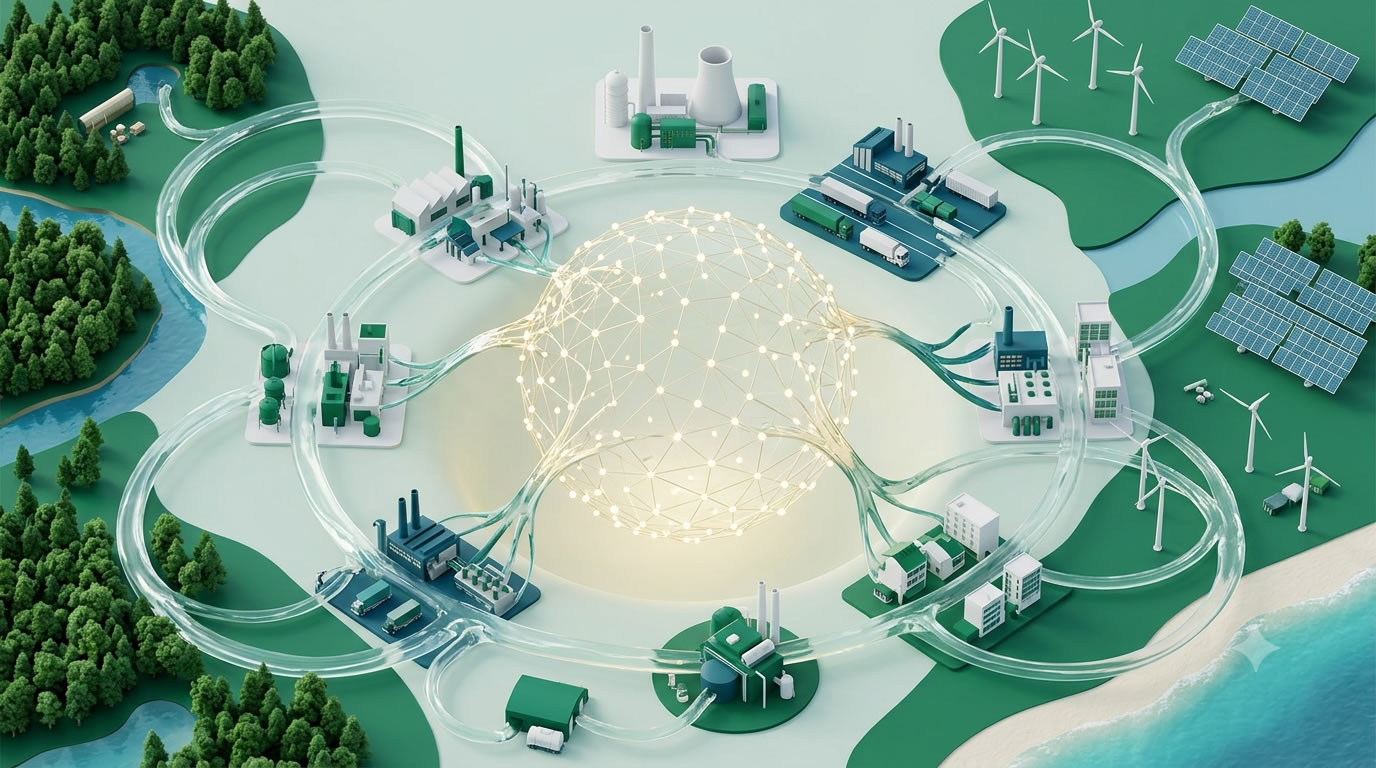
However, much of the literature adopts a predominantly technological perspective, overlooking how AI is embedded in strategic and decision-making processes. It thus becomes crucial to understand how AI is actually incorporated into business models. From this perspective, AI can be interpreted as a cognitive infrastructure, capable of shaping what firms are able to perceive, analyze, and implement (Sjödin et al., 2023; Neri et al., 2023). Building on these premises, this contribution outlines an integrated framework in which circular business models, dynamic capabilities, and AI are interconnected and coevolve across three levels. The structural level is represented by CBMs, which define the architecture of value creation and are shaped by path dependency (Geissdoerfer et al., 2020). The processual level is constituted by dynamic capabilities, which act as the transformation mechanism through sensing, seizing, and reconfiguring (Teece, 2007). The enabling level is represented by AI, which acts as a cognitive and informational infrastructure, enhancing such capabilities and expanding firms’ analytical and decision-making potential (Warner & Wäger, 2019). Within this framework, AI is not an external element but a constitutive component of dynamic capabilities: it extends sensing through predictive analytics, enables data-driven seizing, and supports organizational and inter-organizational reconfiguring processes (Sjödin et al., 2023). The framework also highlights the ambivalent relationship between AI and path dependency. On the one hand, AI can reinforce existing configurations by improving efficiency; on the other, it can contribute to redefining performance metrics, renegotiating supply chain relationships, and enabling new value configurations (Tutore et al., 2024). At the same time, AI introduces new forms of dependency related to data infrastructures, technical standards, and digital systems, potentially generating technological lock-in (Neri et al., 2023). Finally, the transition toward CBMs increasingly unfolds within ecosystem contexts characterized by interdependencies among firms, institutions, and digital platforms (Adner, 2017; Jacobides et al., 2018). In such settings, coordination and “translation” capabilities become critical, enabling the integration of diverse languages and logics across actors. These capabilities act as microfoundations of dynamic capabilities and allow the transformation of data and algorithms into strategic decisions (Nonaka & Takeuchi, 1995). As a result, circular innovation emerges not merely as an intra-organizational process, but as a relational and systemic phenomenon.
Conclusions
The framework proposed here offers a way to reinterpret the role of artificial intelligence in circular economy transitions, highlighting its nature as a cognitive infrastructure embedded within dynamic capabilities. AI emerges as a key lever for expanding firms’ capabilities of perception, decision-making, and reconfiguration, while also potentially reinforcing or reshaping existing constraints. The transformation of circular business models thus appears as a coevolutionary process, in which technology, organizational capabilities, and ecosystem relationships interact and mutually influence one another. In this perspective, the transition toward a circular economy does not depend only on the adoption of advanced technologies, but also on the development of coordination and translation capabilities that can make AI use truly transformative.
References
- Adner, R. (2017). Ecosystem as structure: An actionable construct for strategy. Journal of management, 43(1), 39-58.
- Bocken, N. M., De Pauw, I., Bakker, C., & Van Der Grinten, B. (2016). Product design and business model strategies for a circular economy. Journal of industrial and production engineering, 33(5), 308-320.
- Geissdoerfer, M., Savaget, P., Bocken, N. M., & Hultink, E. J. (2017). The Circular Economy–A new sustainability paradigm?. Journal of cleaner production, 143, 757-768.
- Geissdoerfer, M., Pieroni, M. P., Pigosso, D. C., & Soufani, K. (2020). Circular business models: A review. Journal of cleaner production, 277, 123741.
- Jacobides, M. G., Cennamo, C., & Gawer, A. (2018). Towards a theory of ecosystems. Strategic management journal, 39(8), 2255-2276.
- Neri, A., Negri, M., Cagno, E., Kumar, V., & Garza‐Reyes, J. A. (2023). What digital‐enabled dynamic capabilities support the circular economy? A multiple case study approach. Business Strategy and the Environment, 32(7), 5083-5101.
- Nonaka, I., & Takeuchi, H. (1995). The Knowledge-Creating Company. The Knowledge-Creating Company How Japanese Companies Create the Dynamics of Innovation. Nonaka, I., & Takeuchi, H. (1995). The Knowledge-Creating Company. The Knowledge-Creating Company How Japanese Companies Create the Dynamics of Innovation.
- Prisco, A. (2025). L’economia circolare per lo sviluppo delle PMI. Modelli teorici e leve manageriali. Wolkers Kluwer, Milano.
- Reim, W., Sjödin, D., & Parida, V. (2021). Circular business model implementation: A capability development case study from the manufacturing industry. Business Strategy and the Environment, 30(6), 2745-2757.
- Rosa, P., Sassanelli, C., Urbinati, A., Chiaroni, D., & Terzi, S. (2020). Assessing relations between Circular Economy and Industry 4.0: a systematic literature review. International Journal of Production Research, 58(6), 1662-1687.
- Santa‐Maria, T., Vermeulen, W. J., & Baumgartner, R. J. (2022). How do incumbent firms innovate their business models for the circular economy? Identifying micro‐foundations of dynamic capabilities. Business Strategy and the Environment, 31(4), 1308-1333.
- Sjödin, D., Parida, V., & Kohtamäki, M. (2023). Artificial intelligence enabling circular business model innovation in digital servitization: Conceptualizing dynamic capabilities, AI capacities, business models and effects. Technological Forecasting and Social Change, 197, 122903.
- Sydow, J., Schreyögg, G., & Koch, J. (2009). Organizational path dependence: Opening the black box. Academy of management review, 34(4), 689-709.
- Teece, D. J. (2007). Explicating dynamic capabilities: the nature and microfoundations of (sustainable) enterprise performance. Strategic management journal, 28(13), 1319-1350.
- Teece, D. J., et al. (1997). Dynamic capabilities and strategic management. Strategic Management Journal, 18(7), 509–533.
- Tutore, I., Parmentola, A., Di Fiore, M. C., & Calza, F. (2024). A conceptual model of artificial intelligence effects on circular economy actions. Corporate Social Responsibility and Environmental Management, 31(5), 4772-4782.
- Vergne, J. P., & Durand, R. (2011). The path of most persistence: An evolutionary perspective on path dependence and dynamic capabilities. Organization Studies, 32(3), 365-382.
- Warner, K. S., & Wäger, M. (2019). Building dynamic capabilities for digital transformation: An ongoing process of strategic renewal. Long range planning, 52(3), 326-349.