by Anita Valentini
Art & Humanities Department, CSAIA ETS
President of the ModoFiorentino Cultural Association
Art historians and artists, with the support of computer scientists and software developers, today use artificial intelligence (artificial intelligence, hereinafter AI) also and above all in association with cinema, considering it not as an isolated technological opportunity, but as the evolution of a long historical chain of technological revolutions, from the camera obscura to digital photography.
AI – CINEMA AND ARTISTIC PRODUCTION Historical Continuity and the Concept of “Authorship”
AI can be considered a new medium, fully entering into an old debate.
Artistic production has always assimilated new technologies after initially opposing them. Photography in the nineteenth century and digital technology in the twentieth century raised exactly the same fears that exist today regarding the “death of art,” supposedly brought about by the use of AI in the artistic field.
It therefore becomes necessary to redefine the concept of authorship: just as Marcel Duchamp, the great artist of Dadaism and Surrealism, with his Ready-mades, or Andy Warhol, the undisputed father of Pop Art, with the Factory, the cinematic artist moves from manual production to conceptual selection.
AI thus becomes an executive assistant, while the human being remains the director of the idea.
What about the loss of the “aura”? Referring to the theory of the German philosopher Walter Benjamin (1892–1940), technical reproducibility reaches its highest point—indeed, it surpasses it—starting from an entirely new situation and going beyond what had previously seemed conceivable: an AI-generated cinematic image has no physical “original”; consequently, the artist “creates” a work of art, shifting the value of the work from its material uniqueness to the idea of its creator and the experience of the viewer.
The visual impact and cinematic aesthetics are changing and must “feed on history” in order to create the present and the future, just as has always happened throughout the history of artistic creation. We may even hypothesize the return of Mannerism—whose artists worked “in the manner” of the great masters of the early sixteenth century while giving their works a new and personal imprint—and of Surrealism. AI excels at blending unrelated elements, creating dreamlike visions reminiscent of Salvador Dalí or René Magritte. In cinema, this makes it possible to move beyond photorealism in favor of a hyper-expressive and deliberately distorted aesthetic, characteristic of Mannerism, such as that of Jacopo Pontormo or Parmigianino.
Without hesitation, we can speak of quotationism and postmodernism, both of which have always been present, as already mentioned, throughout the evolution of artistic styles and the history of art: AI models feed on the past. The art critic observes that generative cinema—or rather, first and foremost, its creator—tends toward “hyper-quotationism”: the algorithm recombines artistic styles and historical periods, merging, for example, Caravaggio’s Baroque with cyberpunk science fiction, creating an endless postmodern collage that possesses its own value.
In cinema, even the aesthetics of error (Glitch Art): can become an asset. The early imperfections of AI, such as extra fingers or impossible architectural structures, for the purposes of artistic creation, are not merely technical mistakes but become genuine visual artistic stylistic features, just like the textured brushstrokes of the Impressionists that disturbed nineteenth-century audiences.
Nevertheless, we cannot ignore the risks arising from the approximate use of AI to create artistic products.
The first, especially from the perspective of an art critic, concerns the homogenization of taste. If the algorithm is based on the “average” of existing data, the risk lies in the loss of the incisiveness and depth of an idea. Cinematic art combined with AI risks becoming an endless replication of styles already assimilated by audiences, penalizing genuine avant-garde creativity.
Furthermore, in many cases, we cannot ignore the risk of losing historical memory, which, as we have already emphasized, is fundamental. If AI learns only from partial or commercial databases, the complex and millennia-old history of Italian art—as well as that of the great civilizations that developed in Europe, China, or India—ends up being reduced to a handful of simplified and standardized visual clichés, offering very little to the creativity of contemporary artists.
The task of the artist, the art historian, and the art critic is to ensure that this does not happen by providing all the necessary and stylistically accurate data.
Above all, the artist must infuse the technical process of creating his or her work with his or her own soul.
AI-CINEMA AND THE DISSEMINATION OF ITALIAN ART Added Value for Cultural Diplomacy
The combination of artificial intelligence and cinema represents an unprecedented turning point for cultural diplomacy.
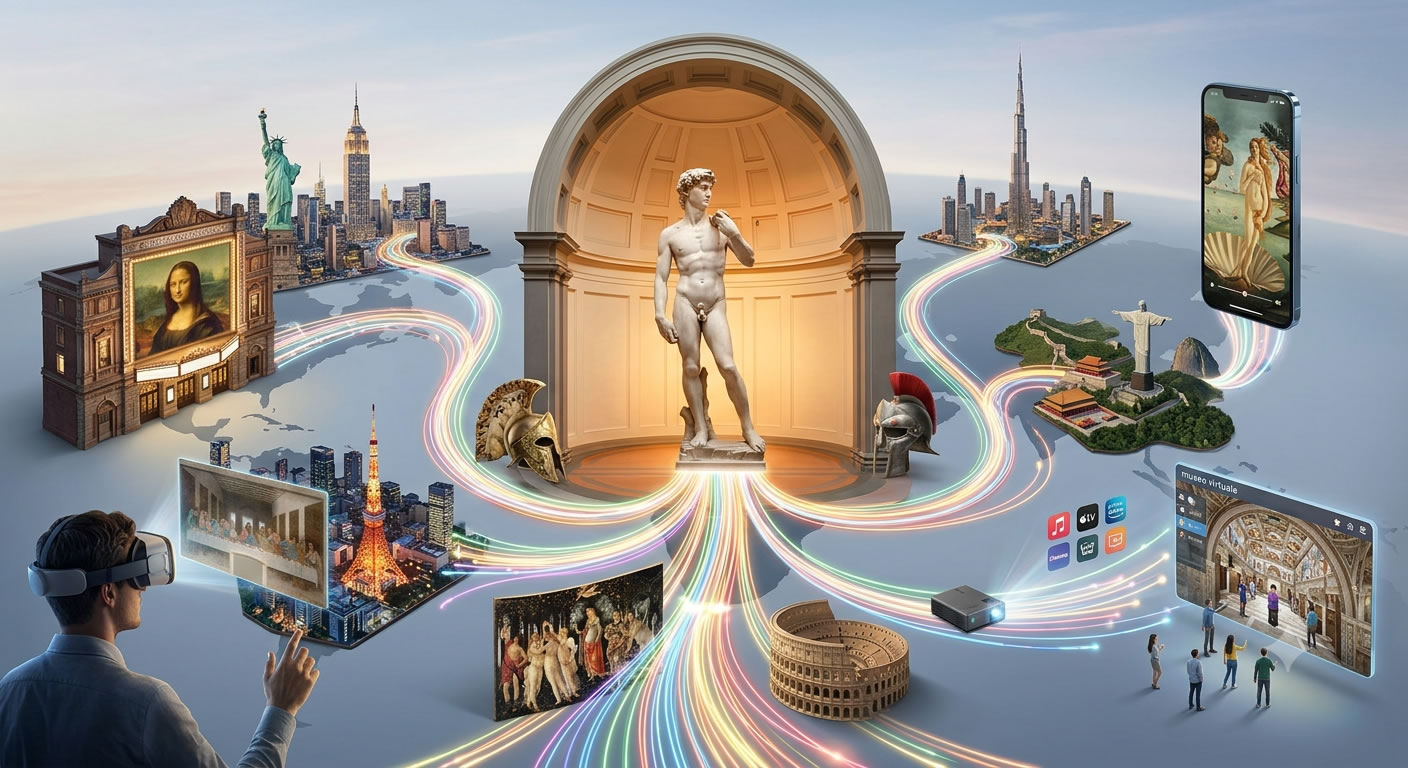
This synergy makes it possible to overcome the physical limitations of distance and the static nature of traditional museums, as well as palaces, places of worship, and archaeological sites.
When speaking about AI and Italian art, until recently people generally thought of software capable of generating a digital imitation of a painting, such as The Birth of Venus (c. 1485), one of the best-known masterpieces by Sandro Botticelli, housed in the Uffizi Gallery in Florence.
Today, we must reverse this perspective.
We must not imitate the past, but use AI to dematerialize stone and pigment, transforming them into a cinematic code capable of traveling anywhere in the world.
Cinema, enhanced by AI, transforms localized works of art—such as the fresco cycle depicting the Stories of Genesis and Saint Peter in the Brancacci Chapel by Masolino, Masaccio (1424–1428), and Filippino Lippi (1480–1485), located in the Brancacci Chapel of the Church of Santa Maria del Carmine in Florence—into dynamic, interactive, and globally exportable digital assets.
AI can recreate, analyze, expand, or reinterpret the history of Italian art through cinematic and documentary media.
The international dissemination of Italian art through AI-enhanced cinema is not merely a matter of “tourism promotion,” but rather a genuine challenge involving content scalability, linguistic accessibility, and the democratization of the visual experience.
AI and cinema together constitute a fundamental combination for several aspects of art dissemination.
AI and cinema are unparalleled in bringing historical contexts back to life. AI can digitally reconstruct the urban and architectural settings of different historical periods, such as Renaissance Florence or Baroque Rome. Cinema transforms these reconstructions into immersive films, showing works of art where and how they originally came into being.
Another valuable contribution concerns translation and cultural localization. What is the real limitation of art documentaries abroad? Subtitles that distract viewers from the artwork, or dubbing that diminishes the narrator’s expressive emphasis.
Indeed, the first obstacle to the international dissemination of Italian art is language itself and the complexity of Italian art criticism. AI enables emotional synthetic dubbing in real time into dozens of different languages while preserving the voice and expressive nuances of Italy’s greatest cultural communicators. This makes it possible to instantly break down linguistic barriers abroad.
Multimodal Language Models (LMMs) solve the language problem at its root. Using Transformer-based voice models (models capable of analyzing relationships between audio frequencies and facial expressions to generate photorealistic videos) together with Neural Lip-Sync (an artificial intelligence technology that realistically synchronizes mouth movements with an audio track), we can have one of our cultural communicators speak flawless Chinese, Arabic, or Norwegian. Their voice, tone, and emotional expression are preserved, without language barriers. The original narrator’s voice clone can speak perfectly in another language, with perfect lip synchronization matching the cultural communicator or actor. This is not deepfake technology for its own sake: it is photorealistic cultural translation.
For the international dissemination of our culture, another important aspect concerns hyper-personalized storytelling. AI-based generative cinema can produce art documentaries adapted to the visual preferences of different countries—for example, emphasizing dramatic chiaroscuro for Asian audiences or highlighting geometric precision for Northern European viewers.
AI technologies therefore have the potential to revolutionize the dissemination of Italian cultural heritage, and within this context the role of the art historian becomes fundamental—indeed, crucial.
In this scenario, the art historian must not disappear; on the contrary, they must evolve from a simple guardian of memory into the scientific director of content.
The historian must become the guarantor of historical truth: AI generates images based on probabilistic calculations rather than historical truth, often producing anachronistic historical inaccuracies. The historian’s task is to philologically validate every generated frame (anti-hallucination).
At this new stage of cultural dissemination, the art historian also assumes the role of curator of the training dataset, ensuring that AI does not represent Italian art through stereotypical clichés or poor-quality imagery. The historian must select sources, documents, and images, ensuring the scientific reliability of the data used to train the algorithms.
Furthermore, the historian must also act as the writer of the emotional bridge (Storytelling). AI processes data, but it does not possess the critical intuition or empathy necessary to explain why a work of art is a masterpiece. The art historian writes the narrative structure that cinema subsequently translates into images.
Ultimately, the art historian, together with AI, continues to carry out their profession, which consists of research, critical analysis, and writing.
ARTISTIC PRODUCTION AND DISSEMINATION Further Possibilities and a Consideration
Furthermore, the role of AI in the restoration and conservation of both films and works of art is fundamental.
Through predictive film restoration, advanced algorithms integrated into documentary productions can visually “complete” deteriorated film footage, showing audiences the original splendor of the work in high definition.
AI algorithms are capable of removing defects from old documentary films, just as they can reconstruct lost frescoes or missing parts of architectural structures, providing an overall visualization of them; a capability that is particularly useful for educational purposes.
Nor should the role of AI in the various stages of film production be overlooked. AI is widely used for the aging and de-aging of actors (De-aging): actors can portray great artists both in their youth and old age without the need for heavy makeup in historical films or artist biopics.
Moreover, AI is an indispensable tool for predictive directing and storyboarding: directors can use AI software to instantly generate cinematic sketches in the style of Botticelli or Leonardo.
The transition from medieval to Renaissance painting is based on the mathematical encoding of space. For cinema technicians and computer vision specialists, this translates into the fundamental concepts of camera calibration and depth estimation.
The Renaissance is the ideal historical period from which to draw inspiration in demonstrating the power of AI in digital restoration, 3D reconstruction, and cinematic CGI (Computer Generated Imagery; computer-generated images; the use of machine learning algorithms to create, modify, or enhance computer graphics, animation, and visual effects), precisely because the artists of that era were, in effect, the “programmers” and visual engineers of their time.
And today, we are their heirs.
CONCLUSIONS
Italian art resides in museums, palaces, and churches because its physical substance is, for the most part, immobile. Photography and cinema have documented it; today, artificial intelligence makes it alive, interactive, and exportable.
We should not fear generative models. AI will not destroy art, artists, or art historians because it will be—and must be!—guided by human beings and for human beings.
It will be the AI medium that will carry the Renaissance and the other great periods of Italian art into the future of world cinema.